

TAIC Report: Air NZ Engine Fire Caused by Blade Crack Missed in Overhaul, Evacuation Took Too Long
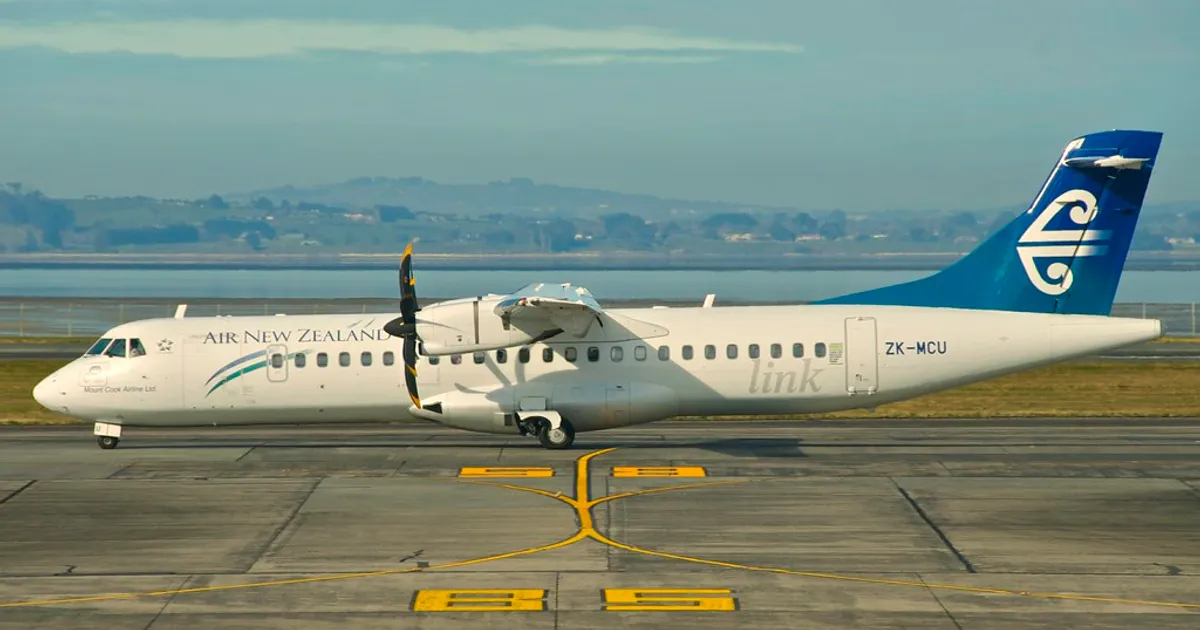
The photograph above, supplied with the original source article, shows Air New Zealand Link ATR 72-500 aircraft ZK-MCU at Auckland. It is included as an aircraft image and is not the ATR72 involved in the Wellington incident.
A Transport Accident Investigation Commission (TAIC) report has found that an Air New Zealand ATR72 engine fire near Wellington in September 2024 was caused by a fatigue crack in a turbine blade that was missed during an overhaul carried out by the engine manufacturer less than four flying hours earlier.
The aircraft landed safely, and no one was killed. However, the subsequent evacuation took two minutes and 51 seconds, almost twice the 90-second certification benchmark. TAIC said the incident highlighted two separate safety issues: the need for stronger quality assurance during engine overhauls and the importance of passengers leaving carry-on baggage behind when instructed to evacuate.
What happened on the Air New Zealand flight
The Christchurch-to-Wellington flight was carrying 70 passengers and four crew members on 1 September 2024. The ATR72-600 was approaching Wellington Airport when a low-pressure turbine blade in the left engine failed.
A low-pressure turbine is the section of a turboprop engine that helps extract energy from hot gases to drive the propeller. The blade failed through fatigue cracking. A gradual weakening process that can develop over time.
The blade failure caused vibration and damaged internal air seals. Oil then leaked into the engine, producing smoke and flames and triggering a fire warning shortly before landing.
The pilots declared a mayday and continued the approach. The aircraft landed safely and stopped on the runway. Fire suppressant was discharged into the engine area, but the fire warnings remained illuminated. The captain then ordered the passengers and crew to evacuate.
TAIC reported that some passengers sustained minor injuries during the evacuation, but there were no fatalities.

Blade crack was missed during the overhaul
The engine had been overhauled by Pratt & Whitney Canada less than four flying hours before the incident. According to TAIC, the fatigue crack that caused the turbine blade to fail was not identified during the manufacturer’s quality checks.
A second blade from the same engine also showed signs of fatigue.
TAIC chief investigator of accidents Louise Cook described the event as a “rare but serious technical failure”. She said the incident demonstrated why maintenance assurance must be strong enough to detect fatigue before critical components are returned to service.
The Commission has recommended that Pratt & Whitney Canada strengthen its overhaul quality assurance procedures.
Air New Zealand chief safety and risk officer Nathan McGraw said the report found no evidence that Air New Zealand’s maintenance or operation contributed to the blade failure. The finding is significant because the airline operated the aircraft and managed the flight, but the engine overhaul and inspection were carried out by the manufacturer.

Evacuation took 2 minutes 51 seconds
The report found that the aircraft evacuation took two minutes and 51 seconds. The 90-second benchmark is used during aircraft certification tests to assess whether a passenger aircraft can be evacuated rapidly under specified conditions.
TAIC chief investigator Louise Cook warned that when an evacuation takes longer than 90 seconds, “the risk to life increases exponentially”.
Passenger behaviour contributed significantly to the delay. Investigators found that:
- At the forward-right exit, 10 of the 12 passengers took baggage with them.
- At the forward-left exit, eight of 15 passengers took baggage. Those passengers then walked close to the engine that had been on fire.
- At the rear-left exit, an estimated 17 of 42 passengers took baggage.
Passengers did not all respond in the same way. TAIC found that some did not remember the safety briefing or could not hear the crew clearly. Others copied passengers who stopped to retrieve bags. Some felt less urgency because they could not see flames, while a few ignored instructions.
The flight crew also did not make an evacuation radio call. As a result, airport fire crews had to switch from their firefighting role to managing passengers without being told that an evacuation was under way.
The report also identified the need for clearer instructions to passengers after they leave an aircraft. Several passengers exiting through the forward-left door moved near the engine that had been on fire, creating an additional hazard.
Air New Zealand outlines corrective actions
Air New Zealand has accepted the report’s findings and outlined several measures intended to strengthen evacuation preparedness.
The airline plans to:
- Develop a cabin emergency evacuation trainer.
- Strengthen training on the ATR’s rear service door.
- Update passenger safety briefing material.
- Align evacuation commands across its fleet.
- Tell passengers more explicitly to leave their bags behind.
- Improve instructions for passengers after they exit the aircraft.
The changes focus on areas within the airline’s control. TAIC’s recommendation to Pratt & Whitney Canada addresses the separate engine inspection and overhaul issue.

Wider context: other Air New Zealand engine investigations
The ATR72 incident follows other serious engine-related events investigated by TAIC.
In December 2024, an Air New Zealand A320neo travelling from Wellington to Sydney experienced an uncommanded engine shutdown at 36,000 feet while carrying 142 passengers. The crew declared a mayday and diverted to Auckland. TAIC’s 2025 interim report traced the event to a defective fire switch.
In 2017, a Rolls-Royce Trent 1000 engine failed on an Air New Zealand Boeing 787-9 near Auckland. TAIC’s 2020 report found that the manufacturer’s fatigue prediction model could not reliably forecast the blade failure. Affected blades were eventually replaced across 99 per cent of the global fleet.
These incidents involved different aircraft, engine types and technical issues. However, they each raised questions about the quality of manufacturer processes and the ability of airlines to manage risks arising from outsourced work.
The wider lesson is straightforward: outsourcing a maintenance task does not outsource the operational, safety or financial risk. Airlines remain responsible for the safe operation of their fleets, even when specialist work is completed by a manufacturer or external supplier.
The next test will be whether Pratt & Whitney Canada acts on TAIC’s recommendation and whether stronger assurance procedures can prevent similar fatigue-related defects from reaching service.
Financial pressure from engine availability problems
The safety report also comes at a challenging time for Air New Zealand.
In its FY2026 results, the airline reported a net loss after tax of NZ$242 million on revenue of approximately NZ$7.0 billion. Engine availability problems involving Rolls-Royce Trent 1000 and Pratt & Whitney PW1100 engines were estimated to have cost about NZ$190 million through lost capacity, additional leasing and engine costs, and lower fleet utilisation.
Maintenance costs rose by NZ$139 million, and the airline did not declare a final dividend.
The ATR72 blade failure is separate from the engine availability issues affecting the airline’s other fleets. Nevertheless, the events illustrate how technical reliability, maintenance assurance, aircraft availability and financial performance are closely connected in aviation.
For Air New Zealand, the priority remains maintaining safe operations while working with manufacturers and regulators to address the causes of technical disruption.
Practical safety reminder for passengers
The TAIC findings provide an important reminder for everyone who flies, including Sri Lankans living in New Zealand and families travelling between New Zealand, Sri Lanka and other countries.
If a crew member orders an evacuation:
- Leave all carry-on bags behind. Bags can block aisles, slow other passengers and cause people to stumble. Retrieving them can also place passengers near fire, hot surfaces, propellers or other hazards.
- Listen carefully to the safety briefing. The information may be needed during a rare but time-critical emergency.
- Follow crew instructions immediately. Do not wait to see flames or smoke before acting.
- Use the exit directed by the crew. The nearest exit may not be the safest exit in a particular situation.
- Move away from the aircraft after leaving. Follow instructions from cabin crew, airport fire crews and other emergency personnel.
The 90-second benchmark exists because aircraft emergencies can develop quickly. Leaving baggage behind is not simply a procedural preference; it helps passengers move faster and gives others a clearer path to safety.
This is a general safety reminder, not a criticism of passengers or any airline. In an unexpected event, clear briefings, direct crew commands, well-practised procedures and passenger cooperation all contribute to a safer outcome.

What the report means for New Zealand aviation safety
The Wellington incident ended without fatalities because the aircraft landed safely and emergency services responded. TAIC’s findings nevertheless show why aviation safety depends on several layers working together.
Manufacturers must inspect critical components effectively. Airlines must maintain strong oversight of contracted work and prepare crews for realistic evacuation conditions. Passengers must listen, move promptly and leave their belongings behind when instructed.
For New Zealand’s aviation sector, the report provides a clear opportunity to strengthen those layers. For the travelling public, its most immediate message is equally clear: in an evacuation, follow the crew and leave the bags.
Readers interested in further New Zealand and international community reporting can explore eLanka’s articles section, which covers news and stories of interest to Sri Lankans living around the world.
Sources
- B2B News: Air NZ engine fire caused by blade crack missed four hours after overhaul
- Transport Accident Investigation Commission: Passenger aircraft engine fire and evacuation, 1 September 2024
- TAIC inquiry: ATR72-600 ZK-MVL engine fire and evacuation at Wellington
- TAIC Recommendation 026/26: engine manufacturer quality assurance
- TAIC Recommendation 027/26: passenger evacuation and post-evacuation management
- RNZ: Inquiry finds evacuation took too long after engine fire on Air NZ flight
- 1News: Missed cracks sparked Air NZ engine fire, evacuation took too long
- NZ Herald: Air NZ flight fire and passengers taking carry-on bags during evacuation
- Air New Zealand 2026 annual results market release
- NZX: Air New Zealand announces 2026 annual results
At eLanka, we respect the rights of creators. If we have used an image you own and you’d like it removed, please email us at info@elanka.com.au and we’ll handle it promptly.
Thanks.
eLanka team
eLanka Disclaimer
Content published on eLanka may be created by the eLanka team, submitted by contributors or third parties, reproduced or adapted from other sources with appropriate source acknowledgement, or provided as promotional/advertising material by our clients. While eLanka takes reasonable care in preparing and publishing content, we do not warrant its completeness or accuracy. Views expressed are those of the respective authors or contributors and do not necessarily represent the views of eLanka. Third-party contributors, content providers and advertisers are responsible for the accuracy of material they supply and for ensuring they hold the necessary rights and permissions for its publication. Advertising and promotional content should not be regarded as an endorsement by eLanka of any product, service or claim.


